The Skillet Secret: Why Slower is Better for Farm-Fresh Heritage Eggs
There is something deeply satisfying about walking out to the coops in the morning, looking across the morning mist on St. Mary's Bay, and collecting a basket filled with deep chocolate brown, pale blue, and vibrant green eggs.
Here at Bayview Acres, our multi-colored laying flock isn't just for show. These hens spend their days doing what chickens do best—scratching through our coastal Belliveau Cove pastures, foraging for bugs, and soaking up the fresh Nova Scotia air.
Because our birds are pasture-raised and allowed to live a natural, slow-paced life, the eggs they produce are entirely different from what you buy at a conventional grocery store. The yolks are a deep, vibrant orange, the whites are thick and structured, and the flavor is rich and robust.
But because true heritage, pasture-raised eggs are more nutrient-dense and structurally firm, they shouldn't be treated like commodity eggs in the kitchen. Today, we are sharing our favorite, no-nonsense farm kitchen method to unlock their full potential.
The Recipe: The Perfect Low-and-Slow Farm Scramble
Conventional eggs have thin, watery whites that cook instantly—and dry out just as fast. Our fresh eggs have incredible protein structure. To keep them velvety, rich, and tender, the secret is cooking them low and slow.
Ingredients:
- 4 to 6 Bayview Acres multi-colored table eggs
- 1 tbsp unsalted butter or lard
- 1 tbsp fresh seasonal herbs (chives or parsley work beautifully)
- A pinch of coarse sea salt and cracked black pepper
Instructions:
1. Whisk with Care
Crack your eggs into a bowl. Notice how sturdy the shells are and how the yolks stand tall—that is the mark of a healthy, pasture-raised hen. Whisk them vigorously with a fork just until the yolks and whites are combined and slightly frothy. Do not salt them yet; salting too early can draw out moisture during cooking.
2. Mind the Heat
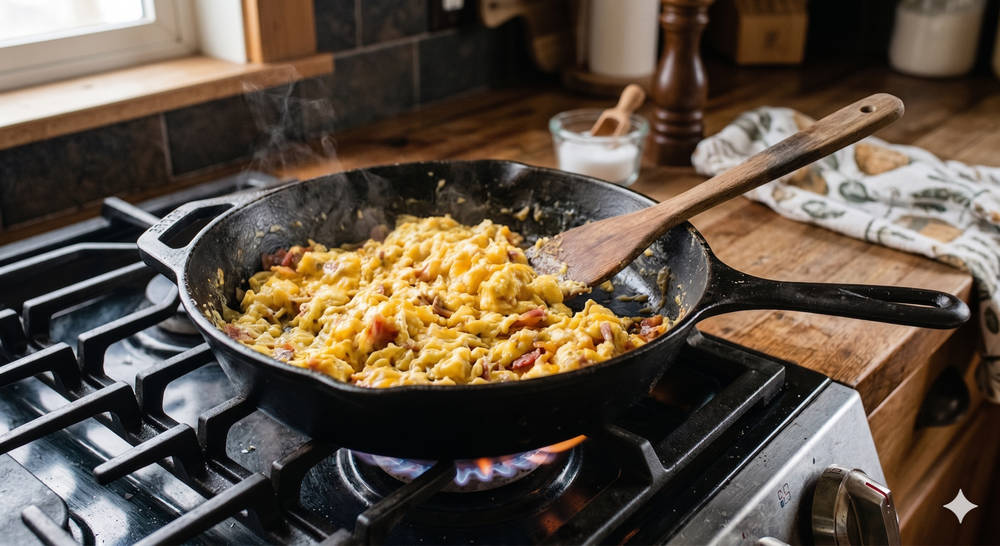
Melt your butter or lard in a small skillet over low heat. You should never hear a loud sizzle when your eggs hit the pan. If the fat is smoking, your pan is too hot. Take it off the heat for a minute to cool down.
3. Cook Patiently
Pour in the eggs. Let them sit untouched for about 30 seconds, then use a silicone spatula to gently sweep the eggs from the outer edges to the center. You are looking to form soft, pillowy curds, not a hard fry.
4. Pull Them Early
Remove the pan from the burner while the eggs still look slightly wet and glossy. The residual heat from the skillet will finish cooking them to absolute perfection without drying them out.
5. The Finishing Touches
Gently fold in your fresh herbs, salt, and pepper right before serving. Enjoy them alongside a thick slice of sourdough for a true, grounded farm fresh breakfast.
Bring the Farm to Your Table
Our hens are currently in full production, rotating through our coastal pastures to bring you the highest quality multi-colored table eggs in Digby County.
At just $6.00 per dozen, you can taste the difference that rotational grazing and transparent, family-oriented farming make.
How to Get Your Eggs: Because we run a direct-to-consumer operation focused on absolute freshness, our egg quantities are limited by what the hens give us each morning. We stock the mini fridge in our egg stand at the farm every day so stop by and grab a dozen or more. Cash and e-transfer accepted.